Long weekend, because it's Cyprus National Day and the weather is great and so it's time for a sail.

Out to Cape Greko for the night. Tim, myself and Jacko, a friend of Tim's from South Africa.

The wind is very low, so the Asymmetric is the order of the day...

Jacko is taking all the photos, so there is the unusual occurrence of photos of both me and Tim in the the cockpit together!

Just past Cape Pyla there is a large fish farm. It's charted, but still not the place to get entangled with.
We set off about 14:00 so arrived at Cape Greko just as the sun was setting.

The overnight wind was from the north so we decided to anchor in the south bay. You enter by creeping round this rock and staying as well clear of the antennas as possible.

It's not an anchorage we have been into before and so Tim and I are peering out to check what it's like. The photo makes it look lighter than the twilight we had.

The antennas are something to avoid. Normally we stand off about 2 nautical miles. Too many boats have wrecked their navigation instruments on the HF transmitters. However, it's a beamed array, so it's only south of the beam that is dangerous. The bay in the north and the one to the south that is actually to the west of the transmitters is quite safe.

I did find that my trusty iSailor chart plotter was not quite accurate in this bay. No we didn't anchor on land... the chart is wrong! The depth is the same for both iSailor and RayMarine chart plotter, but the depth is wrong, it's about 2m more than chart datum.

The following morning we see what the bay is really like. The anchor dragged a little, when the wind turned from southerly to northerly, but dug in firmly after that. Our anchor alarm went of in the early hours, so Jacko and I got up to check while Tim, unusually, slept soundly!
So much mention of Jacko, so here's a photo early in the morning. He looks more awake than I feel!
This is the rock on the west of the back from the bay side as we are leaving to return to Larnaca.

It's Asymmetric time...

Wind as predicted? Hmmm... if it had been as forecast we would have made the plotted chart line.

And finally back to Larnaca Marina.
All in all a very enjoyable sail.



 The wind is very low, so the Asymmetric is the order of the day...
 Jacko is taking all the photos, so there is the unusual occurrence of photos of both me and Tim in the the cockpit together!
 Just past Cape Pyla there is a large fish farm. It's charted, but still not the place to get entangled with.
 The overnight wind was from the north so we decided to anchor in the south bay. You enter by creeping round this rock and staying as well clear of the antennas as possible.
 It's not an anchorage we have been into before and so Tim and I are peering out to check what it's like. The photo makes it look lighter than the twilight we had.
 The antennas are something to avoid. Normally we stand off about 2 nautical miles. Too many boats have wrecked their navigation instruments on the HF transmitters. However, it's a beamed array, so it's only south of the beam that is dangerous. The bay in the north and the one to the south that is actually to the west of the transmitters is quite safe.
 The following morning we see what the bay is really like. The anchor dragged a little, when the wind turned from southerly to northerly, but dug in firmly after that. Our anchor alarm went of in the early hours, so Jacko and I got up to check while Tim, unusually, slept soundly!

 It's Asymmetric time...
 Wind as predicted? Hmmm... if it had been as forecast we would have made the plotted chart line.
 And finally back to Larnaca Marina.

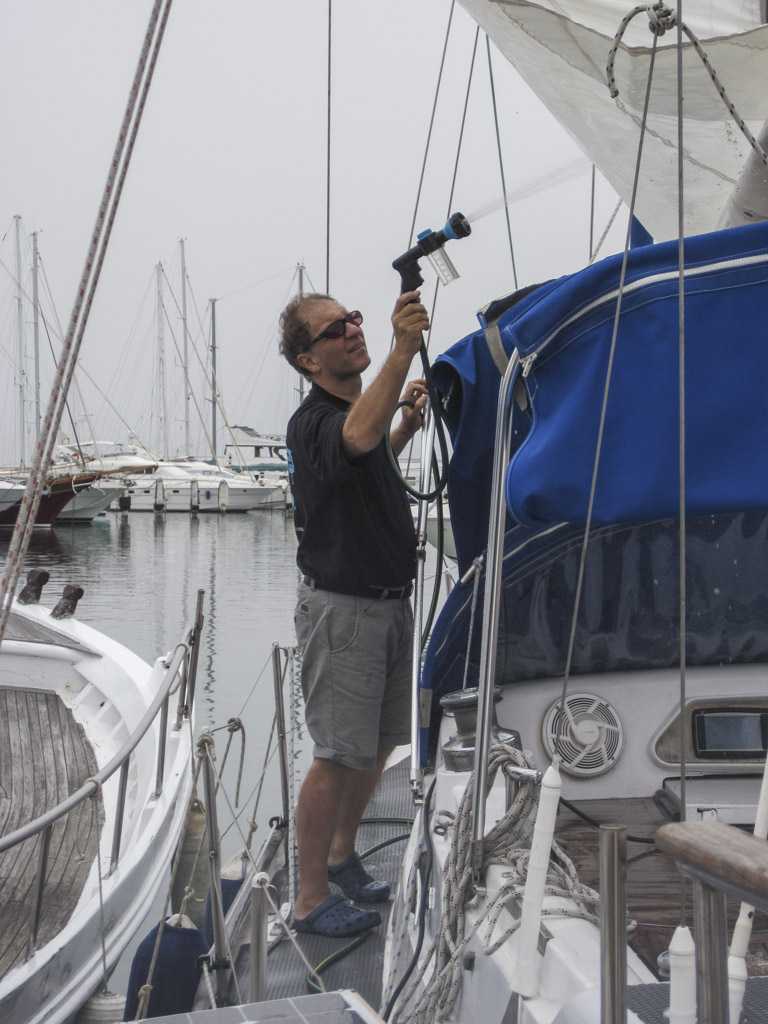 We couldn't get all the dust off, so as we put it back up we rinsed it down and let the slurry run over the boat, which then needed cleaning!
 It's amazing how much higher tall people like Tim can reach. Shorties like me climb to get some places and Tim just reaches up!
 So, having done that, let's take King Malu out for a brief sail...


 11 Watts of wind and...

 One of the biggest problems on sailing boats with solar panels is shading. There is so much gear that can shade the panel! These two photos illustrate it exactly. But note that we are developing flexible smaller panels... in each case there are two panels not one. Hence, in the first photo, one of the panels has 40% shaded (low output) and the other 5-10% shaded (close to full output). On the other side of the boat one of the panels is 100% shaded (almost no output) and the other 5% shaded (almost full output). If these were single large panels then they both would be significantly reduced output power.


